Start with realistic rent, deduct vacancy and operating costs, then account for financing. Gross rental yield is useful for a quick comparison, but it does not tell you whether rent will cover the mortgage or whether the investment suits your cash position.

What is gross rental yield?
Gross rental yield is scheduled annual rent divided by the purchase price, multiplied by 100.
Suppose a property costs RM600,000 and the assumed rent is RM2,500 a month. Twelve months of rent is RM30,000, giving a gross yield of 5%. This assumes full collection for all twelve months and ignores expenses.
How do vacancy and costs change the result?
Consider this illustrative annual budget:
| Item | Amount |
|---|---|
| Scheduled rent | RM30,000 |
| One month without rent | −RM2,500 |
| Management and sinking fund charges | −RM3,600 |
| Repair allowance | −RM1,200 |
| Insurance and property taxes | −RM1,200 |
| Net operating income before financing | RM21,500 |
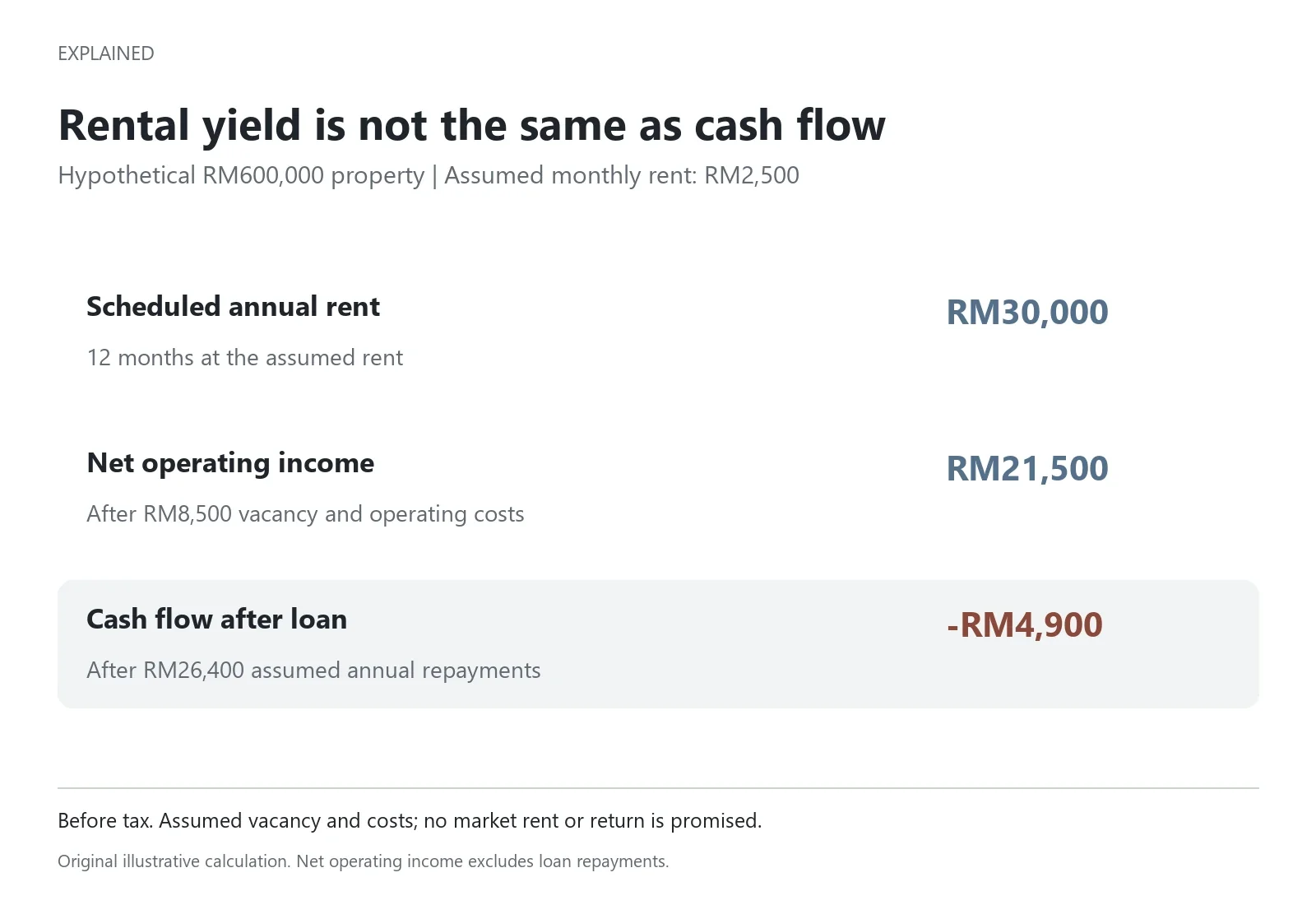
On the RM600,000 purchase price, that produces an illustrative net operating yield of about 3.58%. Letting fees, replacement furniture and other expenses would reduce it further if applicable. Using the full acquisition and furnishing cost as the denominator also changes the result.
Is net rental yield the same as cash flow?
No. Net operating yield in this example excludes loan repayments. If total annual instalments are assumed to be RM26,400, the resulting annual cash flow is negative RM4,900 before income tax and any further expenses. That is about RM408 per month to fund from elsewhere.
Loan instalments include principal as well as interest. Negative cash flow is therefore not the same calculation as an accounting loss, but you still need enough cash to pay the bills.
How do you choose a realistic rent?
Compare similar units in the same building or immediate area. Match size, furnishing, condition and tenancy type. An advertised rent shows the landlord's expectation; it is not proof that a tenant has agreed to pay it.
Check competing supply and the type of tenant the home is likely to suit. An investment dependent on uninterrupted occupancy at the highest advertised rent deserves a more cautious budget.
What should you stress-test?
Try a lower rent, a longer vacancy and a repair bill. Check whether the property remains manageable without assuming future price appreciation. Expected transport improvements can be part of the discussion, but the cash-flow calculation should stand on its own assumptions.
Sources and data notes
- Illustrative calculations and scenario prepared for this guide; no market rent or vacancy rate is claimed.
- Maybank: Mortgage Banking Fees, for the separation of financing and transaction expenses, checked 2 November 2026.
- All expenses shown are hypothetical allowances. This is a before-tax illustration, not an investment return promise.