The cash needed for a subsale house includes your contribution to the price, transaction expenses and any work before moving in. The income you need depends on the approved loan, your other commitments and the bank's assessment. There is no single salary threshold that fits every buyer.

How much cash should you prepare?
Suppose a house costs RM500,000 and financing covers 90% of that price. The buyer's price contribution is RM50,000. A booking or earnest deposit that forms part of the price should be counted within that contribution, rather than added a second time. The documents must confirm how each payment is treated.
You also need a separate budget for the sale and purchase agreement, loan documentation, valuation, stamp duty, searches and other disbursements. Obtain itemised quotations rather than relying on one general percentage. Applicable first-home relief may reduce stamp duty but does not remove the other costs.
What if the bank valuation is lower than the price?
Here is a hypothetical example. The agreed price is RM500,000, but the bank accepts a value of RM470,000 and lends 90% of that value. The resulting loan is RM423,000. You would need RM77,000 towards the price, before fees and other costs.
That is RM27,000 more cash than the RM50,000 contribution in the earlier example. Actual financing margins and valuation treatment depend on the lender's terms.
How much would the monthly repayment be?
For an illustrative RM450,000 fully amortising loan over 30 years:
| Assumed annual interest rate | Approximate monthly repayment |
|---|---|
| 4.00% | RM2,148 |
| 4.50% | RM2,280 |
| 5.00% | RM2,416 |
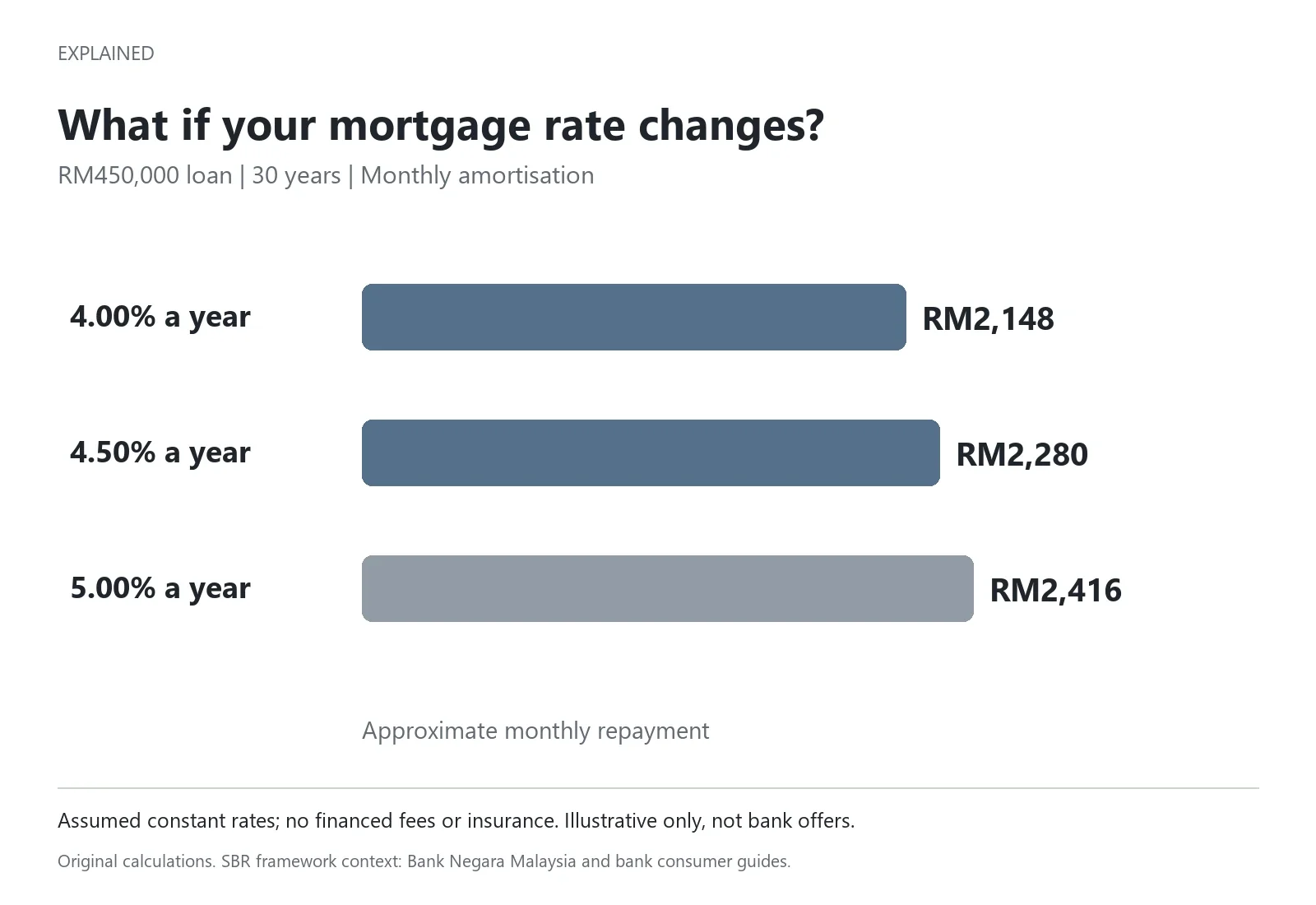
The calculation uses monthly repayments, a constant rate for the full term and no financed fees or insurance. The move from 4% to 5% adds about RM268 a month. This is a sensitivity example, not a forecast of rate changes.
What should you compare between loans?
For new retail floating-rate loans, the Standardised Base Rate, or SBR, is linked to Bank Negara Malaysia's Overnight Policy Rate. The effective rate also includes the bank's spread. Compare the effective rate and relevant terms, not the SBR alone.
Ask about the lock-in period, early settlement, extra repayments, redraw fees and whether insurance or other costs are financed. Banks assess debt service ratios and income differently; do not treat one generic ratio as guaranteed approval.
Finally, add property running costs to the instalment. Keep money for repairs and normal family needs after moving in.
Sources and data notes
- Bank Negara Malaysia: Revised Reference Rate Framework and related consumer guide.
- Hong Leong Bank: Mortgage Loan Info Centre, frequently asked questions.
- Maybank: Mortgage Banking Fees and Home Loan Upfront Costs, checked 2 November 2026.
- All property values and loan rates in the examples are assumptions. Repayments use the standard amortisation formula and are rounded to the nearest ringgit.